






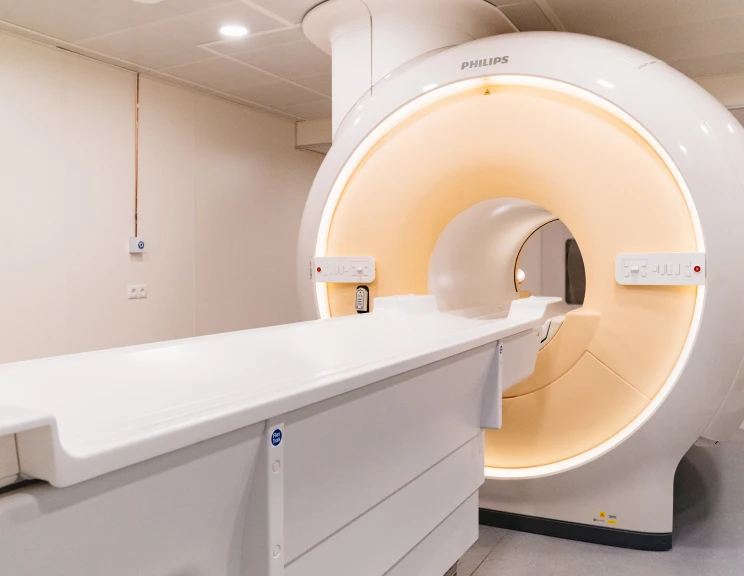




















Known for its strengths in electronics, robotics, and computing, Japan has effectively harnessed this technological foundation to become a leader in advanced digital health solutions. The country's digital health market is projected to reach approximately 6.15 billion USD in 2024, outpacing even China’s growth of 54 million USD. As artificial intelligence continues to evolve, Japan's healthcare landscape is becoming increasingly dynamic, with AI playing a central role in the country’s cutting-edge medical applications.
Cancer detection with AI-powered medical imaging
Endoscopes play a crucial role in early cancer detection, with Japanese companies dominating the global market with a 98% share. In oncology, AI-powered imaging tools have demonstrated significant improvements in early cancer detection in Japan, with market projections highlighting a rapid growth to an anticipated 14.8 billion USD by 2033. However, interpreting endoscopic images remains a complex task that requires over a decade of experience for specialized physicians. To address this challenge, a Japanese startup AI Medical Services (AIM) is transforming diagnostics by embedding the expertise of highly-skilled doctors into an advanced AI system. Their AI-powered tool analyzes images of the stomach and colon captured during endoscopy to assess the likelihood of future cancer development.
Trained on more than 200,000 high-resolution endoscopic videos from over 100 medical institutions across Japan, the AI system can interpret still images and live video in real time. It can also help physicians highlight suspicious areas during procedures to reduce oversight. AIM’s tool delivers impressive performance, analyzing a single image in just 0.02 seconds and detecting cancer with approximately 94% accuracy.
Academic and clinical research institutions in Japan are also pioneering AI applications in medical imaging. Researchers at the Cancer Institute Hospital in Tokyo have developed AI models for gastric cancer detection that outperform human endoscopists, achieving up to 98.6% sensitivity for tumors larger than 6mm. These AI systems are refined through rigorous clinical trials and regulatory processes to ensure safety before widespread implementation. Furthermore, the Japanese government is planning to invest around 100 billion USD over the next 5 years to build AI-powered hospitals. According to Grand View Research, 10 such hospitals are expected to be established to tackle workforce shortages and growing healthcare costs.
To further assist healthcare professionals in medical diagnostics and imaging, FPT offers a wide range of diagnostic technologies, including CT, MRI, X-ray, and ultrasound. With deep expertise in integrating advanced imaging systems like PACS and RIS, FPT enables seamless access to medical data through DICOM viewers and AI-assisted diagnostic tools. Leveraging AI, FPT delivers smart imaging systems that streamline diagnosis and assist in early disease detection, having successfully supported over 160 medical device SMEs in Japan.
AI role in dental care and education
Japan is leading the way in integrating AI into dental care and education by leveraging its advanced technological infrastructure to transform clinical practice. The Japan dental care market stands as one of the largest in the Asia-Pacific region, marked by significant market value and consistent growth with a CAGR of 6.85% through 2030.
To accelerate this growth, AI is transforming dental care by utilizing machine learning and computer vision to analyze large amounts of dental data with remarkable speed and accuracy. Trained on extensive datasets of dental images and patient records, AI can detect patterns and identify early signs of oral diseases such as cavities, gum disease, and even oral cancer. AI-powered systems also allow clinicians to simulate and visualize different treatment options to help doctors improve decision-making. By automating routine tasks, AI reduces clinician workload and improves the quality of patient care.
In dental education, recent studies in Japan emphasize the growing potential of AI tools such as ChatGPT. Specifically, ChatGPT 4o mini demonstrated strong performance by passing the Japanese National Dental Examination for two consecutive years, outperforming earlier versions such as ChatGPT 3.5 and Google's Gemini. In the 117th National Dental Exam, GPT-4o achieved an 88.6% score in compulsory questions, significantly surpassing GPT-4’s score of 74.3%. These results reflect AI's increasing utility in helping students and professionals master complex dental concepts, which further showcases AI’s capabilities in dental education and training.
In line with AI advancements in dentistry, FPT’s DentalLab platform is transforming dental workflows through powerful AI automation. DentalLab streamlines 2D and 3D image processing by handling segmentation, registration, and detection with high speed and accuracy. As a result, dental professionals can generate detailed 3D models from CT/CBCT DICOM files in under 5 minutes and perform precise segmentation of crowns and gingiva in just 1 minute. DentalLab’s manual controls allow clinicians to fine-tune results, while the 3D treatment simulator enables virtual tooth repositioning for personalized planning. By reducing manual workload and enhancing diagnostic precision, DentalLab can improve efficiency, treatment quality, and patient communication in modern dental care.
Find out more about DentalLab here: https://fptsoftware.jp/industries/healthcare/dental-lab.
Towards a safe future of healthcare with ethical AI initiatives
As healthcare increasingly relies on AI, ensuring patients’ data privacy is critical. In response, Japan is taking a leading role in pioneering "sovereign AI", an approach that emphasizes the development of AI models and infrastructure within national borders. This strategy protects sensitive patient data, fosters public trust, and ensures compliance with international regulatory frameworks.
Japan’s commitment to sovereign and responsible AI development is further reflected in its regulatory approach. In March 2025, Prime Minister Shigeru Ishiba emphasized a balanced framework that fosters AI innovation while managing potential risks. Unlike the more rigid regulatory models in the EU and the U.S., Japan opts for a flexible strategy that leverages existing laws and encourages voluntary industry guidelines. The introduction of a new AI bill in February 2025 and a Cabinet Office interim report further highlight this approach to ensure transparency and global alignment without hindering innovation.

FPT announced strategic partnership and investment with Sumitomo and SBI Holdings.
To support the sovereign AI initiative in Japan, FPT Corporation has announced a strategic partnership with Japan’s Sumitomo Corporation and SBI Holdings to accelerate AI development through the FPT AI Factory ecosystem in April 2025. This collaboration combines FPT’s technological capabilities with the broad networks and market expertise of two of Japan’s leading conglomerates. Together, they aim to deliver cutting-edge AI solutions across industries to advance sovereign AI capabilities and further integrate AI into all facets of Japanese society. Central to this initiative is FPT AI Factory’s “Build Your Own AI” initiative, which focuses on democratizing access to AI. The platform enables organizations and individuals to build custom AI applications using their data and expertise, supported by advanced GPUs, pre-built models, deployment tools, and a comprehensive AI ecosystem for competitive advantage.
FPT - Accompany the future of healthcare in Japan
As the digital health landscape continues to evolve, Japan offers critical insights for other nations seeking to leverage technology to strengthen healthcare systems and improve patient care at scale. On the journey to accelerate healthcare innovations for Japan, FPT serves as a trusted partner.
With 17+ years of experience in healthcare, over 1,000 AI experts, and adherence to global standards such as Hi-Trust, GDPR, HIPAA, and ISO 13485, FPT delivers end-to-end solutions from system design to DevOps and operations. Focusing on Healthcare & Life Sciences, FPT leverages AI and cloud technologies to enhance workforce productivity, unify data for personalized services, and enable patient-centered care at scale.
Discover our healthcare services: https://fptsoftware.com/industries/healthcare


