


























In the global business landscape, data is vital to achieving operational excellence. Today, 90% of enterprise analytics and business professionals indicated that data and analytics are critical to their organization’s digital transformation initiatives. Nevertheless, enterprises have to encounter various challenges to manage and optimize data effectively.
Big Data - Big challenges

Large data volume
Due to the boom of data in recent years, data can be overwhelming for traditional data storage and processing systems, requiring new approaches for managing and analyzing. Most companies are increasing the amount of data they collect daily. Eventually, a traditional data center's storage capacity will be inadequate, which worries 43% of IT decision-makers in the technology sector regarding this data influx.
Talent shortage
A significant shortage of skilled data analysts exacerbates the data challenges. In fact, the growth of data analysis jobs is so promising that the field might be developing too quickly for companies to keep pace with hiring data scientists. According to research, 63% of companies indicated that their organizations are moderately worried about the talent shortage.
Inadequate data cataloging
To optimize data successfully, companies need to refine and improve the quality, efficiency, and utility of data within an organization, ensuring that data is organized and accessible. However, businesses are experiencing inadequate data cataloging – which involves systematic data organization and categorization. Inefficient data cataloging can lead to data silos, data duplication, and a fragmented data landscape.
Limited understanding of data
As today’s datasets might each follow their own particular logic and require a deeper understanding of how data is extracted and structured, businesses might encounter limited understanding due to data complexity. This lack of comprehension hinders effectively optimizing data usage, leading to poor data quality and observability.
Leveraging AI-driven Data Analytics

Following the advancement of AI, enterprises are integrating this innovative technology into their data strategies. This approach entails leveraging AI to enhance various aspects of analytics processes, from analyzing raw data to extracting insights. Instead of manually creating reports for each analysis, AI tools can generate reports automatically. Enterprises can realize the benefits of AI-powered data analytics, including:
- Deeper data insights: Machine learning models can recognize patterns, identify correlations, and identify trends within the datasets. Additionally, these systems can pinpoint relationships between different data points, revealing dependencies and illustrating how changes in one variable impact another. Leveraging AI-powered data analytics, enterprises can gain deeper insights into customer behavior, market trends, and operational efficiency, enabling them to make informed decisions.
- Simplified analytics solution development: AI simplifies the setup of platforms for developers and analytics engineers by providing intuitive natural language instructions for tasks such as configuring user interfaces, managing user permissions, and customization. This eliminates the need for manual configuration based on documentation or coding complex structures, streamlining the development process.
- Competitive advantage: A robust AI-driven analytics solution can offer a competitive advantage across various domains, providing invaluable support in managing the analytics setup, such as creating workspaces and implementing changes to logical data models. Research by IBM indicated that 63% of cross-industry respondents acknowledge the competitive advantage thanks to data analytics.
- Enhanced productivity: AI analytics plays a crucial role in enhancing enterprise operations, leading to increased efficiency and productivity. Through the automation of repetitive tasks and the streamlining of processes, AI analytics enables businesses to save valuable time and resources on more critical tasks instead of manually adjusting reports and dashboards.
- Better customer relationships: Utilizing machine learning algorithms, AI can analyze customer purchase history and behavior to provide personalized product or service recommendations. This level of personalization enhances the customer experience, making interactions more relevant and prompting customers to make additional purchases. Thanks to AI, businesses can understand how customers move through various stages of interaction to optimize the customer journey, providing a smoother and more personalized experience.
Find out more on how enterprises can leverage AI to transform digital shopping experience through every stage of customer journey: AI in E-commerce: Reshaping Every Stage of Customer Journey
Power Insights – The right data platform for everyone
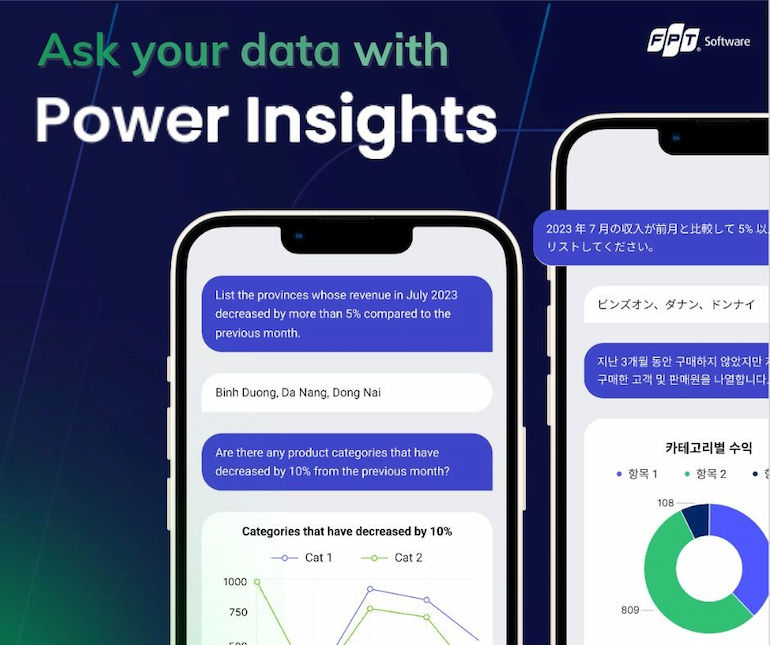
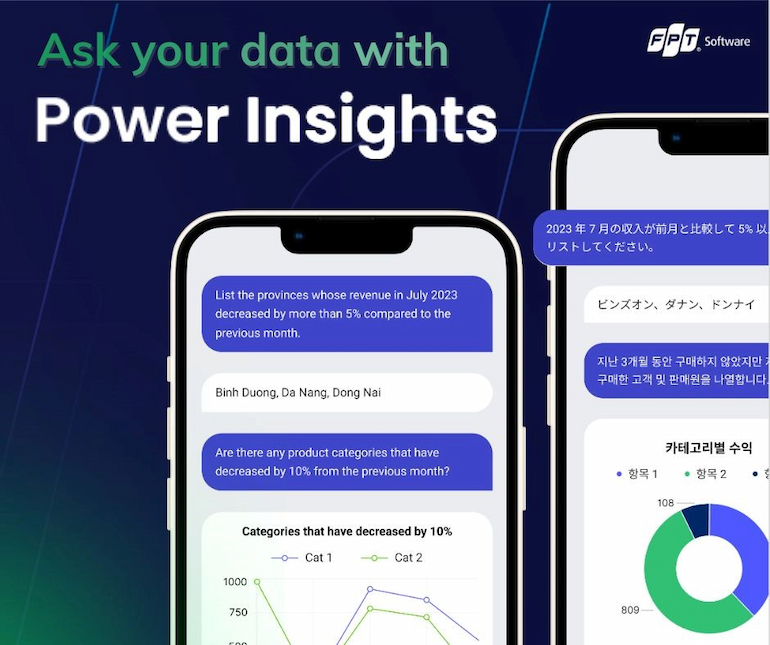
FPT Software’s Power Insights platform
Given the potential of AI-driven analytics, PAS - a member of the Enterprise Business Services (EBS, FPT Software) – has developed and introduced a new AI product called "Power Insights". Compared to other conversational AI applications limited to generating texts and images, the platform can help enterprises conduct data analysis and visualizations.
Leveraging the robust foundation of Azure OpenAI technology from Microsoft, Power Insights utilizes Generative AI, Large Language Models, and FPT's data processing and analysis expertise. Users can use Power Insights to extract valuable insights from data through simple conversational language interactions instead of relying on analytical tools or advanced SQL expertise.
Achieving data management and optimization within seconds
With the capability to deliver analysis results in under 30 seconds per response, the platform accelerates decision-making processes and enables users to explore and expand their queries for deeper insights. Significantly, Power Insights contributes to cost reduction by minimizing recruitment and training expenses associated with data analytics and BI system development.
The platform can present answers in text, table, and visually understandable chart formats. Furthermore, Power Insights fosters collaboration within enterprises by facilitating information and insight sharing via popular platforms such as Microsoft Teams and Email. Moreover, the platform eliminates language barriers in data analysis, supporting over 120 languages worldwide.
Its attributes, such as rapid analysis results, short implementation time, error elimination, user-friendly design, and the ability to facilitate deeper questioning, position Power Insights as a comprehensive tool for all organizational levels. For instance, team leaders can benefit by monitoring team performance and streamlining operations, while all employees can utilize this innovative tool for problem-solving and customer service enhancement.
Venturing into the future of data-driven enterprises
Effectively addressing the complexities posed by data is crucial to unlock business opportunities and realize the full potential of data as a strategic asset. In this landscape, AI helps businesses accelerate the decision-making process and enhances the depth and accuracy from the available data.
On the journey towards data transformation, FPT Software is a trusted partner in tackling data challenges. With EBS’s Power Insights, enterprises can seamlessly transition to a data-driven approach and stay ahead of the competition.
To understand more about Power Insights, don’t hesitate to contact us.


